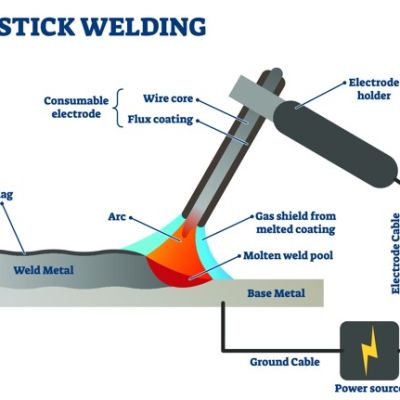
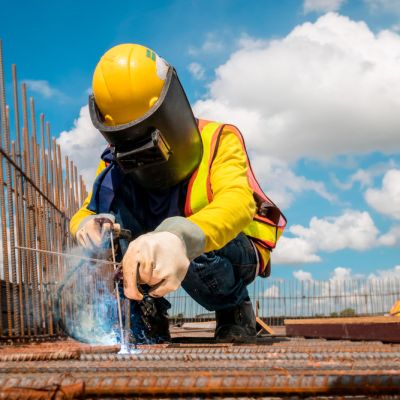
While advanced manufacturing continues to chase automation, robotics, and lasers, arc welding remains the quiet force holding global infrastructure together. From bridges and power stations to pipelines, mines, and shipyards, arc welding is not a legacy process — it is industrial resilience in action.
Arc welding does not pretend to be glamorous. It is trusted because it works — anywhere, anytime, under conditions where other processes simply fail.
Why Arc Welding Still Matters
Arc welding (most commonly SMAW or “stick welding”) thrives where environments are harsh, access is limited, and conditions are unpredictable. Wind, dust, humidity, confined spaces, remote locations — arc welding keeps going.
- This is why it remains dominant in:
- Structural steel and civil construction
- Mining and heavy industry
- Power generation and substations
- Oil, gas, and pipeline maintenance
- Agricultural and plant maintenance
When reliability matters more than aesthetics, arc welding answers the call.
Simplicity Is Not a Weakness
In an era obsessed with complexity, arc welding’s greatest strength is its simplicity.
No wire feeders.
No shielding gas cylinders.
Minimal setup.
Maximum adaptability.
This simplicity translates directly into:
- Faster mobilisation on site
- Lower equipment failure risk
- Easier field repairs
- Greater tolerance for imperfect conditions
Arc welding respects reality — not ideal laboratory environments.
Skill Over Settings
Arc welding places responsibility squarely in the hands of the welder. There is no digital interface to hide behind. Arc length, electrode angle, travel speed, slag control, and heat input must all be managed manually.
This is why arc welding skill is deeply respected across industry.
Organisations aligned with bodies such as American Welding Society consistently emphasise that welder competence, not machine sophistication, is the primary driver of weld integrity in arc welding applications.
Technology assists — but skill decides.
Cost Efficiency Beyond the Spreadsheet
Arc welding is often chosen for its low capital cost, but its true value extends further:
- Consumables are widely available
- Equipment is rugged and repairable
- Training pathways are accessible
- Repairs can be executed immediately
When downtime costs exceed labour costs — which is almost always the case — arc welding becomes a strategic choice, not a budget compromise.
Arc Welding and the Reality of Infrastructure
Much of the world’s infrastructure is aging. Replacement is expensive; maintenance is unavoidable. Arc welding is uniquely suited to this reality because it adapts to what exists, not what was ideally designed.
Old steel, mixed alloys, contaminated surfaces, irregular joints — arc welding meets infrastructure where it is, not where engineers wish it was.
This makes arc welding central to sustainability, extending asset life rather than demanding constant replacement.
The Future of Arc Welding
Arc welding is not being replaced — it is being refocused.
- Advanced electrode formulations
- Improved power source efficiency
- Better safety equipment and PPE
- Enhanced welder training and certification
The process remains manual, but the ecosystem around it is evolving to support higher standards, better outcomes, and safer work environments.